%20(1).avif)
What Are Medical Billing Companies in North Dakota?
Medical billing companies in North Dakota manage claims, denials, payment follow-up, patient balances, and related revenue cycle work for medical practices. Under N.D.C.C. section 26.1-36-37.1 an insurer has 15 business days to pay a clean claim, deny it, or ask for more information. Since January 1, 2026, a prior authorization request the payer mishandles is deemed authorized by law.
North Dakota Practices Are Losing Revenue in Places They Cannot See
North Dakota has one of the shortest claim response clocks in the country and attaches no money to it. An insurer here gets 15 business days, and the statute is satisfied if the payer simply asks you for more information. Nothing in the chapter awards interest on a late payment. The clock is fast, and it is empty.
So the prompt pay law is not where the money is in this state. That moved on January 1, 2026, when North Dakota’s new prior authorization chapter took effect. A payer that misses one of its authorization deadlines does not owe you a penalty. It owes you the authorization. The service is treated as approved by operation of law.
That is a real asset and it has a short shelf life, because it only exists if somebody wrote down the date the request went in and the date the answer came back. Most North Dakota practices are not keeping that log. Which means the strongest position a practice holds in this state is being thrown away every week inside aged AR that looks like an ordinary denial pile.
Medical Billing Services for North Dakota Practices
Full-Service Medical Billing
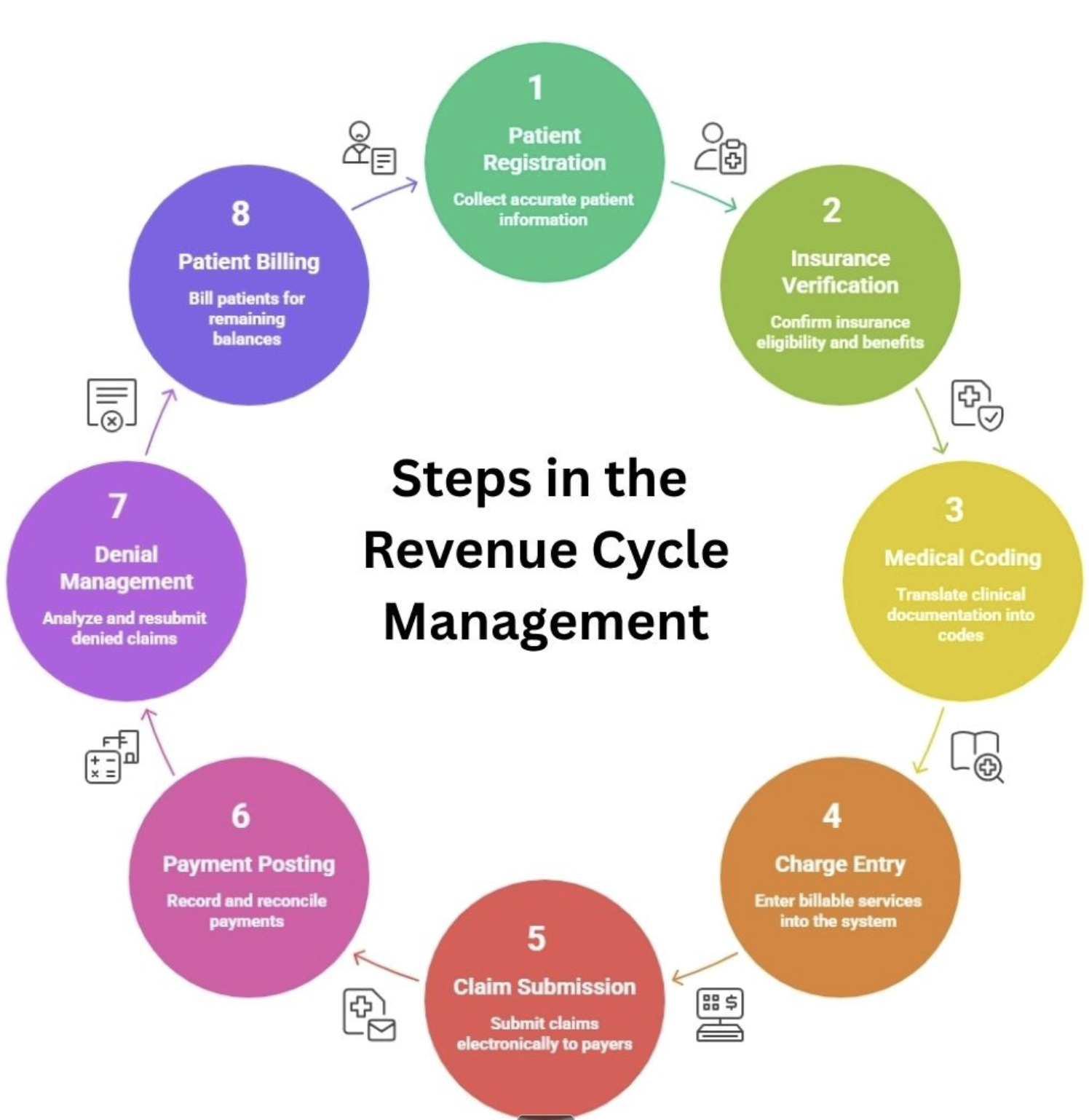
Our full-service medical billing team manages the revenue cycle from eligibility through payment posting and zero balance. Your dedicated team works inside your existing practice management or EHR system instead of forcing you through a disruptive software migration.
Medical Coding
Our certified medical coders review documentation and apply the appropriate coding workflows for your specialty and payer mix. In North Dakota that includes laterality on every injury diagnosis, which Workforce Safety and Insurance requires by rule and enforces on payment.
Denials and AR Recovery
Old accounts are often the fastest place to find recoverable revenue. Our denials and AR recovery service prioritizes aged accounts, identifies denial patterns, works payer responses, and pursues appropriate appeals and follow-up until the account reaches resolution. In North Dakota that starts with the authorization log, because a payer that missed a deadline in chapter 26.1-36.12 has already authorized the service and the denial is arguable on a timestamp.
Eligibility and Benefits Verification
Eligibility problems can create avoidable write-offs and patient-balance confusion. We verify coverage and benefits so your team has the information needed before claims and patient statements move forward. North Dakota runs traditional Medicaid and Medicaid Expansion side by side on different rules and different filing windows, so an eligibility check here decides which clock the claim is on.
Prior Authorization
Since January 1, 2026, North Dakota sets real deadlines: 7 calendar days for nonurgent requests, 72 hours for urgent, and 2 business days for post-stabilization emergency care, with the service deemed authorized if the payer misses. The state created no exemption or gold card program, so the only way to use the law is to date every request and every response. That is how we run prior authorization workflows here.
Patient Billing
Patient balances are part of the revenue cycle too. Our patient billing support keeps statements, balances, and follow-up organized so your practice is not leaving the final portion of earned revenue unattended.
Credentialing
Credentialing problems can delay payments before the first claim is ever submitted. We support provider enrollment and credentialing so practices stay operational with the plans they serve. North Dakota sets no statutory turnaround, and the dominant carrier’s own policy allows up to 180 calendar days from signature, so we date-stamp submissions and work a fixed follow-up cadence instead of waiting.
RCM, CCM and Telehealth
Practices increasingly need billing workflows that account for multiple care models and remote services. We support revenue-cycle processes for RCM, chronic care management, and telehealth programs, with medical virtual assistant support where a practice needs front-office coverage alongside billing.
Dashboards and Automations
You should not need to wait for a monthly spreadsheet to understand what is happening to your revenue. We use reporting and workflow automation to make trends in AR, denials, collections, and billing performance easier to identify and act on.
How Our Medical Billing Process Works
1. Start With a Billing Review
We begin with a 30-minute review of your AR aging, denial patterns, payer mix, and current billing workflow. The goal is simple: identify what is actually costing you money and where we would start.
2. Build the Revenue Recovery Plan
We identify the accounts, payer issues, coding patterns, workflow gaps, and filing risks that deserve attention first. You get a clear view of what should be worked immediately and what needs a process change.
3. Start With the Oldest Money
Working aged AR comes first because it represents revenue you have already earned. Our team works the backlog while establishing a consistent process for new claims and daily billing.
4. Run the Full Cycle
Once the foundation is in place, we take over the agreed portion of the revenue cycle: eligibility, coding, submissions, payment posting, denials, appeals, AR follow-up, patient billing, and reporting.
5. Improve the System, Not Just the Claims
The goal is not to create a permanent cycle of denials and appeals. We look for repeatable patterns so the practice can prevent the same billing problems from occurring again.
Why North Dakota Practices Choose Luxen
20+ Years of Revenue Cycle Experience
Medical billing is not a process you learn from a checklist. Payer behavior, documentation, coding, authorization, and follow-up all require experience. Luxen brings more than two decades of experience to the revenue cycle.
Certified Coders
Coding quality affects everything downstream. Our billing operation includes certified coding expertise so claims are built with greater attention to documentation and payer requirements.
Your Existing EHR and Practice Management System
You do not have to replace the software your practice already uses. Luxen works within your existing system, including platforms such as athenahealth, DrChrono, ModMed, AdvancedMD, NextGen, eClinicalWorks, Meditab, OpenDental, and other systems.
A Named Team, Not a Random Support Queue
You should know who is responsible for your claims. Our model is built around dedicated people working inside your systems and learning the way your practice operates.
HIPAA-Compliant Workflows
Before accessing protected health information, we sign a business associate agreement, and healthcare engagements operate through HIPAA-compliant tooling.
AAPC, AHIMA and SOC 2
Luxen combines billing expertise with professional credentials and documented security and compliance standards, including AAPC and AHIMA expertise, HIPAA-compliant workflows, and SOC 2.
We Read the Numbers Before We Quote
We do not want to sell you a generic percentage based on a generic practice. We look at your AR aging, volume, specialty, payer mix, and denial profile first.

Medical Billing in North Dakota: Understanding the Payer Landscape
North Dakota is a concentrated market, and it is concentrated around one Fargo corporate family. Blue Cross Blue Shield of North Dakota is the dominant commercial carrier here. The 2026 marketplace has three medical issuers total, BCBSND, Medica, and Sanford Health Plan, with 41,014 people enrolled at the close of open enrollment and the large majority of them on BCBSND.
The same corporate family reaches further than most billing teams realize. BCBSND’s parent, Noridian Mutual Insurance Company, also owns Noridian Healthcare Solutions, which is the Medicare Administrative Contractor for Jurisdiction F, the ten-state region that adjudicates North Dakota Part A and Part B. And BCBSND holds the Medicaid Expansion managed care contract, which it has run since January 1, 2022 and still runs for plan year 2026. Commercial, Medicare processing, and Medicaid Expansion all touch the same building in Fargo. When one relationship goes sideways in North Dakota, it is rarely contained to one line of business.
North Dakota Medicaid is a split program and this is where competitor pages get it wrong. Traditional Medicaid is fee for service through Health and Human Services. Medicaid Expansion is single-plan managed care under BCBSND, with its own handbook, its own precertification rules, and its own 60-day appeal window. Calling North Dakota Medicaid a fee-for-service program, as several vendor pages still do, is how a practice ends up filing the right claim to the wrong program. The whole program covers roughly 105,000 people, about 13% of the state, on $1.5 billion a year with 66% federal participation.
Medicare here runs against the national grain. 152,864 North Dakotans were enrolled as of February 2026, and only about 36% of them were in a Medicare Advantage plan, against 55% nationally. Two-thirds of your Medicare book is still Original Medicare going to Noridian under Jurisdiction F rules. That is the reverse of the assumption most billing vendors carry in from Sun Belt states, and it changes where the work sits: less plan-by-plan authorization chasing, far more exposure to a single contractor’s edits and local coverage determinations.
Workers’ compensation here has no second option. It is Workforce Safety and Insurance, an exclusive state fund. State law does not permit private insurers to underwrite workers’ compensation here at all. There is no second carrier to appeal to, no market pressure, and, as covered below, no statutory deadline for WSI to pay you.
Finally, geography. Thirty-six of North Dakota’s 47 acute care hospitals are Critical Access Hospitals, alongside 56 rural health clinics and 15 federally qualified health centers, serving a state that is 39% nonmetropolitan. Five federally recognized Tribes and the Trenton Indian Service Area sit inside the state, and services at IHS and tribal 638 facilities are paid on an encounter rate instead of a fee schedule. For calendar year 2026 that outpatient all-inclusive rate is $826 per visit, with the Medicare outpatient rate at $733 and the inpatient per diem at $5,707. A practice that sees those patients and bills the visit like a commercial encounter collects a fraction of what the visit is actually worth.
North Dakota Billing Rules That Can Affect Your Revenue
180 days from date of service for North Dakota Medicaid fee for service; 365 days for secondary claims and resubmissions
Timely filing
15 business days to pay, deny, or request additional information
Prompt-pay requirement
North Dakota Medicaid, with Medicaid Expansion administered by Blue Cross Blue Shield of North Dakota
State Medicaid program
N.D.C.C. section 26.1-36-37.1 gives an insurer 15 business days from receiving the proof of loss form to pay the claim, pay the uncontested portion, deny it, or make an initial request for additional information. There is no separate deadline for paper and electronic submission. Read the fourth option again, because that is the one payers use. An information request satisfies the statute, and once you answer it the insurer gets a fresh 15 business days from receipt of what you sent.
What the chapter does not contain is any interest provision. Nowhere in 26.1-36 is a late payer required to pay you anything for being late. The only enforcement is section 26.1-36-40, which makes a willful violation a class A misdemeanor and lets the commissioner act against the license. That is a regulatory remedy, not a receivable. In North Dakota the way to shorten payment is to remove the payer’s reason to ask a question: complete documentation at first submission, correct proof of loss, no ambiguity for the information-request branch to attach to.
The rule worth building a process around arrived last January. Senate Bill 2280 passed the Senate 43 to 4 and the House 93 to 0, was signed on April 23, 2025, and created N.D.C.C. chapter 26.1-36.12, effective January 1, 2026. It sets hard prior authorization clocks: 7 calendar days for a nonurgent request, 72 hours for an urgent one, and 2 business days for post-stabilization emergency care, counted from when the payer has all necessary information. An approved authorization is valid for at least six months, twelve months for a chronic or long-term condition, and a new payer must honor the prior payer’s authorization for the first 60 days of coverage. Prior authorization is prohibited outright for medication assisted treatment of opioid use disorder.
Two sections in that chapter are worth more than the rest combined. Section 26.1-36.12-09 bars an insurer from revoking, limiting, conditioning, or restricting an authorization if the care was delivered within 45 business days of the provider receiving it, absent evidence of fraud. And section 26.1-36.12-13 provides that when an insurer fails to comply with a requirement or deadline of the chapter, the services are automatically deemed authorized. A payer that answers a nonurgent request on day nine has not committed a technical foul. It has authorized the service. That is an argument you win with a timestamp, and it only exists if the timestamp exists. Note also what the law does not do: North Dakota has no gold carding or exemption program. Any vendor telling you otherwise has not read the chapter.
North Dakota Medicaid filing windows are short and easy to blow. Fee-for-service claims are due within 180 days of the date of service, half the national norm, on the state timely filing policy. Secondary and tertiary claims with other coverage get 365 days, and so do resubmissions, voids, and replacements, provided the original was timely. Proof of timely filing has to travel with the claim.
The crossover rule is the trap. A Medicare crossover claim is due 180 days from the Medicare EOB date, but cannot be submitted until 60 days after that EOB. The usable window is about four months, not six, and it sits on your dual eligible population, which in a state with 152,864 Medicare beneficiaries and a large long-term care footprint is not a small slice. On the Expansion side, BCBSND allows 60 days to appeal and accepts nothing after that, answers in 30 days or 72 hours expedited, and a state fair hearing must be requested within 120 days.
Workers’ compensation is the most one-sided set of rules in the state. Under NDAC 92-01-02, you have one year from the date of service, or one year from the date WSI accepts liability, to submit a bill. WSI, in return, is required to pay as soon as reasonably possible. That is the entire standard. There is no day count, no interest, and no penalty for a slow payment, and WSI says so plainly in its own provider guidance. Section 92-01-02-45(3) then allows WSI to recover any payment incorrectly made to a provider, with no lookback limit, no notice requirement, and no dispute window written into the rule. Your one real protection is the 30-day appeal from the remittance advice date, which means an unreviewed WSI remittance is a permanent decision after thirty days.
Two more WSI mechanics that quietly cost practices money. Since July 1, 2021, WSI accepts bills only by EDI through its designated clearinghouse, in 837P, 837I, or 837D. The exemption is narrow, under 50 bills a year or demonstrated financial hardship, granted at WSI’s sole discretion, and the rule states the decision is not appealable. And documentation standards are enforced: diagnosis coding must carry laterality, cloned or copied notes are prohibited, and an addendum more than 60 days after the date of service is accepted only at WSI’s discretion. Missing records with a bill can trigger nonpayment plus a penalty under N.D.C.C. section 65-05-07(6). Any occupational medicine, orthopedic, physical therapy, or emergency practice in the oil patch should be running WSI as its own worklist, not folding it into commercial AR.
One federal change lands squarely on this state. CMS Change Request 14342, effective April 24, 2026, tightened Method II Critical Access Hospital professional billing for emergency department services: the service must be furnished in an actual emergency department, on type of bill 85X, revenue code 0981, with CPT 99281 through 99285. Method II professional services are paid at 115% of the physician fee schedule and ride on the UB-04 under the 096X, 097X, and 098X revenue codes. With 36 CAHs out of 47 acute care hospitals, this rule touches a larger share of North Dakota facilities than almost anywhere, and it is the sort of change that produces clean-looking claims that pay wrong for two quarters before anyone notices.
Credentialing is the one place North Dakota gives you nothing. There is no state statute or administrative rule setting a decision deadline on a payer credentialing application. BCBSND’s own policy allows 180 calendar days from the signature date, about 90 days from receipt, and recredentials every 36 months. With no legal clock to hold anyone to, provider enrollment in North Dakota is won purely on submission discipline and follow-up cadence.
North Dakota Medical Practices We Serve
We bill for Critical Access Hospitals, provider-based clinics, and hospital-affiliated specialty groups, where the same encounter can generate a facility claim and a professional claim and nobody downstream is checking that both were actually submitted.
We bill for behavioral health, substance use disorder, and medication assisted treatment programs, in a state with 78 mental health professional shortage designations and only about 35% of the assessed need met, and where prior authorization for MAT for opioid use disorder is now prohibited by statute.
We bill for occupational medicine, orthopedics, physical therapy, and emergency practices carrying Workforce Safety and Insurance volume, where the payer has one year of your patience, no deadline of its own, an open-ended recoupment right, and a 30-day appeal window that closes quietly.
We bill for primary care, family medicine, and internal medicine across rural and frontier North Dakota, where two-thirds of the Medicare book is Original Medicare running through one Jurisdiction F contractor instead of a spread of Advantage plans.
We bill for practices serving tribal communities and IHS and 638 facilities, where an encounter is paid on the all-inclusive rate, and where mixing that up with fee schedule billing is the difference between full payment and a fraction of it.
We bill for practices in Fargo, Grand Forks, and Wahpeton that carry Minnesota plans alongside North Dakota ones, where a missing second-state enrollment writes off a share of every clinic day without ever showing up as a denial reason.
Serving Major North Dakota Markets
Luxen supports these markets remotely, inside the software your practice already uses.
Fargo
Bismarck
Grand Forks
Minot
West Fargo
Williston
Dickinson
Mandan
Fargo holds 136,275 residents and Bismarck 77,963, out of a state population of 799,358. After those two the drop is immediate: Grand Forks is 60,365, Minot 47,308, and everything below it is under 42,000. Minot has lost about 2.2% of its population since the 2020 census while West Fargo has grown. Thirty-nine percent of the state is nonmetropolitan, and 36 of its 47 acute care hospitals are Critical Access Hospitals, so a large share of North Dakota clinical volume is billed under facility rules that do not apply in a metro practice. Fargo, Grand Forks, and Wahpeton sit on the Minnesota line, which means a meaningful number of practices there carry Minnesota payer contracts alongside North Dakota ones.
We run the same model in other states, with the payer rules, filing windows and Medicaid structure rebuilt for each one. See Minnesota medical billing, South Dakota medical billing, Montana medical billing, Wyoming medical billing, Nebraska medical billing, Iowa medical billing, Wisconsin medical billing, Michigan medical billing, Illinois medical billing, Indiana medical billing, Ohio medical billing, Missouri medical billing, Arkansas medical billing, Oklahoma medical billing, Texas medical billing, Louisiana medical billing, Mississippi medical billing, Alabama medical billing, Tennessee medical billing, Kentucky medical billing, West Virginia medical billing, Virginia medical billing, North Carolina medical billing, South Carolina medical billing, Georgia medical billing, Florida medical billing, Pennsylvania medical billing, New York medical billing, New Jersey medical billing, Connecticut medical billing, Rhode Island medical billing, Massachusetts medical billing, Vermont medical billing, New Hampshire medical billing, Maine medical billing, Maryland medical billing, Delaware medical billing, Colorado medical billing, Utah medical billing, Idaho medical billing, Nevada medical billing, Arizona medical billing, New Mexico medical billing, Washington medical billing, Oregon medical billing, California medical billing, Alaska medical billing, Hawaii medical billing, and Kansas medical billing, or start from the full list of medical billing companies and what each one charges.
What North Dakota Practices Say About Working With Luxen
“Our outpatient encounters generated both professional and facility claims, but no one was checking that both sides were submitted. Luxen found 146 encounters where one claim was missing, recovered $49,200 in 90 days, and established a weekly reconciliation process.”
Revenue Cycle Manager, Hospital-Affiliated Specialty Clinic, Bismarck, North Dakota
“Our counselors often began seeing patients through an employee assistance program, but the transition to insurance billing after the approved EAP visits was inconsistent. Luxen created a visit-level tracker, reduced wrong-payer rejections by 82%, and recovered $24,600 from affected accounts.”
Executive Director, Outpatient Behavioral Health Group, Fargo, North Dakota
More engagements are written up in our ambulance billing case study and our dental practice case study.
What Does Medical Billing Cost in North Dakota?
3% to 6% of collections
Luxen's pricing generally falls between 3% and 6% of collections, depending on claim volume, specialty, payer mix, and how much of the revenue cycle your practice hands over.
Larger-volume practices can generally access the lower end of the range because billing economics improve as claim volume increases. A smaller or more complex practice may fall toward the higher end because the amount of work per account is greater.
For comparison, published billing-industry pricing guides commonly place percentage-based medical billing somewhere around the mid-single digits, with higher ranges for smaller or more complex practices.
The more important question, however, is not whether a billing company charges 3%, 4%, 5%, or 6%.
It is what happens to collections after you hire them.
A lower fee attached to weak billing is still expensive.
The Risks of Outsourcing Your Medical Billing
Outsourcing is not automatically the right choice for every practice.
A billing company is a poor fit if you are unwilling to share operational visibility, if the vendor uses a rotating pool of people who do not learn your practice, or if the company cannot explain why your claims are being denied.
There is also a real risk in choosing a vendor that promises aggressive collection improvements without understanding your payer mix and specialty.
That is why Luxen starts with the numbers.
You should see the AR aging. You should understand your major denial categories. You should know what is being worked. And you should know what your billing company believes is realistically recoverable.
The right outsourcing relationship should make your revenue cycle more visible, not less.
How Much Revenue Are You Missing?
Look at your AR aging.
- How much is sitting past 90 days?
- How much is past 120 days?
- Which payers represent the largest outstanding balances?
- What are your top five denial reasons?
- How many claims are repeatedly resubmitted without a clear resolution?
- How much patient responsibility remains uncollected?
- How many claims are approaching a filing deadline?
Those numbers tell a story.
Send us your AR aging and we will tell you where we would start.
A Message From the Luxen Founder
I started Luxen because medical practices should not have to choose between doing great clinical work and running a financially healthy business.
Billing is too important to be treated as an afterthought. When claims are submitted incorrectly, denials sit untouched, or aged AR is ignored, the practice feels it everywhere, from cash flow and payroll to staffing decisions and growth.
Our job is to bring discipline to that part of the business.
We work inside the systems practices already use, build accountable billing workflows, and focus on the revenue that is actually recoverable.
We believe your billing partner should know your numbers, your specialty, your payers, and your practice, not just your account number.
Shivam Pujara
Founder, Luxen Talent (& Madhupa)
More on how we built the Luxen billing team.
.avif)
Transparent, U.S.-Focused Billing Support
Your Practice Keeps Its Systems
You do not need to switch EHR or practice management software to work with Luxen.
Your Data Stays Protected
Luxen healthcare engagements use HIPAA-compliant workflows, and we execute a business associate agreement before accessing protected health information.
Your Team Knows Who Owns the Work
We use a dedicated team model so responsibility does not disappear into a generic support queue.
You Can Start With Aged AR
Many practices begin with their old AR before moving into the daily revenue cycle. That gives both sides the opportunity to demonstrate results before expanding the engagement.
North Dakota Medical Billing FAQs
Why outsource medical billing in North Dakota?
Because in North Dakota the money turns on dates. North Dakota pays no interest on a late claim, so speed comes from giving the payer nothing to ask about. What the state does give you is stronger: since January 1, 2026, an insurer that misses a prior authorization deadline has authorized the service by operation of law, and it cannot walk back an authorization for care delivered within 45 business days. Workforce Safety and Insurance, meanwhile, has no payment deadline at all and can recoup without a lookback limit, and your only protection is a 30-day appeal from the remittance advice. Every one of those is a timestamp somebody has to be keeping.
Do you work with North Dakota Medicaid and Medicaid Expansion?
Yes, and we treat them as two different payers, because they are. Traditional North Dakota Medicaid is fee for service through Health and Human Services, with claims due within 180 days of the date of service. Medicaid Expansion is single-plan managed care administered by Blue Cross Blue Shield of North Dakota, with its own precertification rules and a 60-day appeal window that accepts nothing filed late. Medicare crossover claims are the ones that get lost: they are due within 180 days of the Medicare EOB date but cannot be submitted until 60 days after it, which leaves about a four-month usable window on your dual eligible accounts.
How do you handle denied claims?
We work every denial to resolution, then find the pattern behind it, which is usually a short list of causes repeating. In North Dakota a meaningful share of that work happens before the denial. We log the date every prior authorization request was submitted and the date the payer answered, against the 7-day, 72-hour, and 2-business-day deadlines in chapter 26.1-36.12. When a payer misses one, the claim is not an appeal, it is an authorized service that was denied, and the argument is a page of timestamps. We do the same with the 15-business-day response clock and with Workforce Safety and Insurance remittances, where the appeal window is 30 days and closes for good.
Is this cost-effective for a small North Dakota practice?
Our fee runs 3% to 6% of collections. North Dakota has a low uninsured rate at about 7.2%, so very little is lost at the front desk. It is lost afterward. In a small practice here the recoverable money is usually the facility or professional half of a split encounter that was never submitted, the Medicaid claim that passed 180 days, the Workforce Safety remittance nobody appealed inside 30 days, and the prior authorization the payer answered late that should have been deemed approved.
Book a Billing Review
You do not need another sales presentation.
Bring your AR aging, your denial data, and the questions you already have about your billing operation.
In a 30-minute Billing Review, we will look at where your revenue is sitting, where claims are breaking down, what we would prioritize first, and what outsourcing would cost based on your practice.
Send us your AR aging. We will tell you what we believe is recoverable.
