%20(1).avif)
What Are Medical Billing Companies in Pennsylvania?
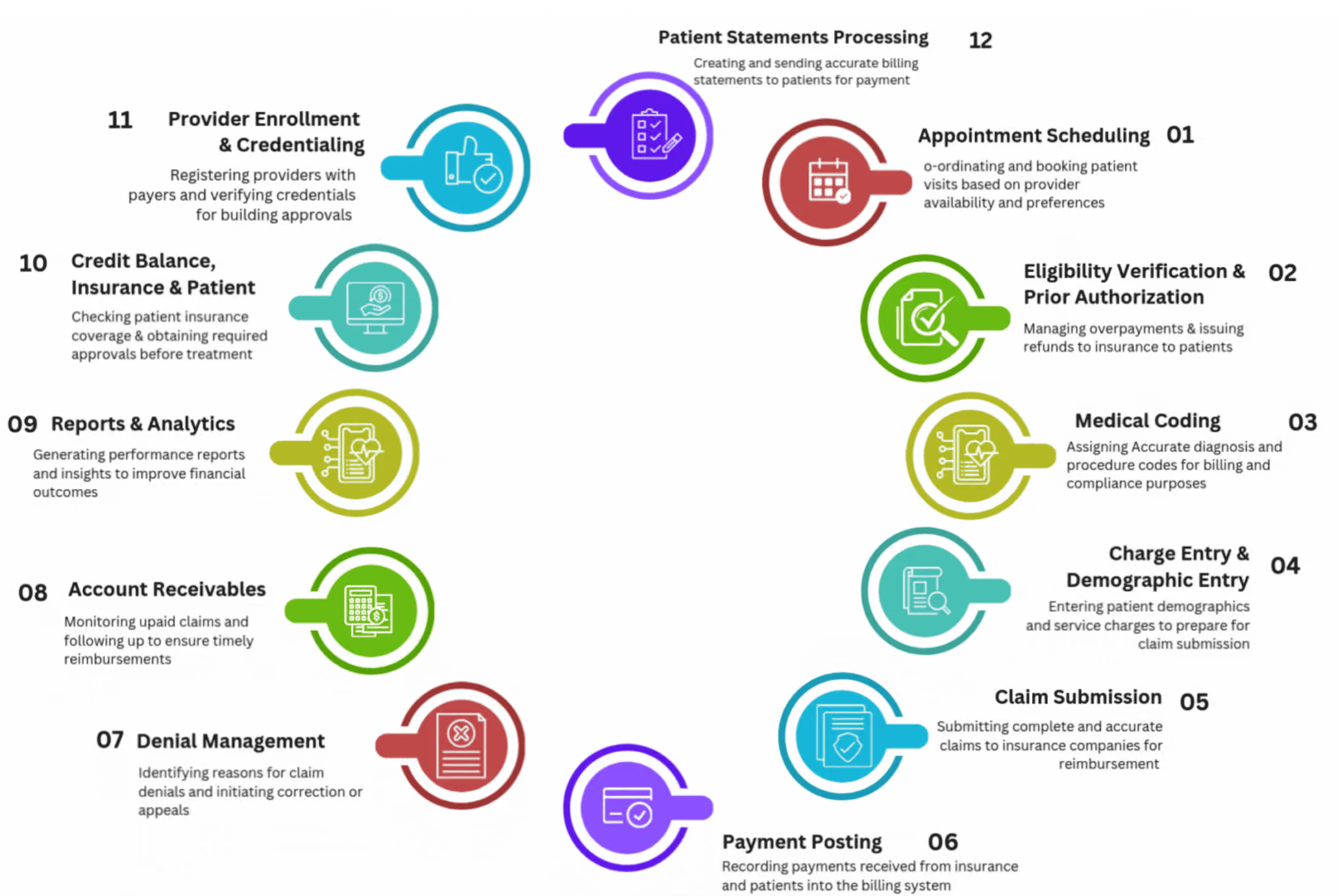
Medical billing companies in Pennsylvania manage claims, payments, denials, appeals, patient balances and related revenue cycle work for healthcare practices. Their work must account for Pennsylvania payer rules, including the requirement under 40 P.S. § 991.2166 that an insurer pay a clean claim within 45 days or add 10% annual interest to the amount owed.
Pennsylvania Practices Are Losing Revenue in Places They Cannot See
Aged AR and unworked denials are the visible problem. In Pennsylvania, the money is usually sitting in a payer system your billing staff was never trained on.
A Pennsylvania practice bills across five Medicaid managed care zones, four separate Blue Cross and Blue Shield territories, and two statutory payer systems that are not health insurance at all: auto injury under Act 6, and workers’ compensation. Each carries its own payment cap, its own clock and its own appeal route.
Most practices work the commercial queue and let the rest age. That is exactly where the recoverable money is. Billing this state properly means eligibility verification before the visit, certified medical coding on the claim, and someone who knows which statute governs the bill.
Medical Billing Services for Pennsylvania Practices
Full-Service Medical Billing
Our full-service medical billing team manages the revenue cycle from eligibility through payment posting and zero balance. Your dedicated team works inside your existing practice management or EHR system instead of forcing you through a disruptive software migration.
Medical Coding
Our certified medical coders review documentation and apply the appropriate coding workflows for your specialty and payer mix. Better coding upstream can prevent avoidable denials downstream.
Denials and AR Recovery
Old accounts are often the fastest place to find recoverable revenue. Our denials and AR recovery service prioritizes aged accounts, identifies denial patterns, works payer responses, and pursues appropriate appeals and follow-up until the account reaches resolution.
Eligibility and Benefits Verification
Eligibility problems can create avoidable write-offs and patient-balance confusion. We verify coverage and benefits so your team has the information needed before claims and patient statements move forward.
Prior Authorization
Authorization requirements vary by payer, plan, service, and specialty. We manage prior authorization workflows so required approvals are addressed before services become preventable billing problems.
Patient Billing
Patient balances are part of the revenue cycle too. Our patient billing support keeps statements, balances, and follow-up organized so your practice is not leaving the final portion of earned revenue unattended.
Credentialing
Credentialing problems can delay payments before the first claim is ever submitted. We support provider enrollment and credentialing so practices stay operational with the plans they serve.
RCM, CCM and Telehealth
Practices increasingly need billing workflows that account for multiple care models and remote services. We support revenue-cycle processes for RCM, chronic care management, and telehealth programs, with medical virtual assistant support where a practice needs front-office coverage alongside billing.
Dashboards and Automations
You should not need to wait for a monthly spreadsheet to understand what is happening to your revenue. We use reporting and workflow automation to make trends in AR, denials, collections, and billing performance easier to identify and act on.
How Our Medical Billing Process Works
1. Start With a Billing Review
We begin with a 30-minute review of your AR aging, denial patterns, payer mix, and current billing workflow. The goal is simple: identify what is actually costing you money and where we would start.
2. Build the Revenue Recovery Plan
We identify the accounts, payer issues, coding patterns, workflow gaps, and filing risks that deserve attention first. You get a clear view of what should be worked immediately and what needs a process change.
3. Start With the Oldest Money
Working aged AR comes first because it represents revenue you have already earned. Our team works the backlog while establishing a consistent process for new claims and daily billing.
4. Run the Full Cycle
Once the foundation is in place, we take over the agreed portion of the revenue cycle: eligibility, coding, submissions, payment posting, denials, appeals, AR follow-up, patient billing, and reporting.
5. Improve the System, Not Just the Claims
The goal is not to create a permanent cycle of denials and appeals. We look for repeatable patterns so the practice can prevent the same billing problems from occurring again.
Why Pennsylvania Practices Choose Luxen
20+ Years of Revenue Cycle Experience
Medical billing is not a process you learn from a checklist. Payer behavior, documentation, coding, authorization, and follow-up all require experience. Luxen brings more than two decades of experience to the revenue cycle.
Certified Coders
Coding quality affects everything downstream. Our billing operation includes certified coding expertise so claims are built with greater attention to documentation and payer requirements.
Your Existing EHR and Practice Management System
You do not have to replace the software your practice already uses. Luxen works within your existing system, including platforms such as athenahealth, DrChrono, ModMed, AdvancedMD, NextGen, eClinicalWorks, Meditab, OpenDental, and other systems.
A Named Team, Not a Random Support Queue
You should know who is responsible for your claims. Our model is built around dedicated people working inside your systems and learning the way your practice operates.
HIPAA-Compliant Workflows
Before accessing protected health information, we sign a business associate agreement, and healthcare engagements operate through HIPAA-compliant tooling.
AAPC, AHIMA and SOC 2
Luxen combines billing expertise with professional credentials and documented security and compliance standards, including AAPC and AHIMA expertise, HIPAA-compliant workflows, and SOC 2.
We Read the Numbers Before We Quote
We do not want to sell you a generic percentage based on a generic practice. We look at your AR aging, volume, specialty, payer mix, and denial profile first.


Medical Billing in Pennsylvania: Understanding the Payer Landscape
Pennsylvania has no single Blue Cross Blue Shield plan. That is the first thing a biller new to the state gets wrong. Highmark holds Blue Cross Blue Shield across 29 western counties, Blue Shield across 21 central counties, and Blue Cross Blue Shield of Northeastern Pennsylvania across 13 northeastern counties, the territory once served by Blue Cross of Northeastern Pennsylvania. Independence Blue Cross covers Philadelphia and southeastern Pennsylvania. Capital Blue Cross covers 21 counties in central Pennsylvania and the Lehigh Valley. The complication is that Blue Cross and Blue Shield licenses were historically held by different companies inside the same territory, so a Blue card tells you very little until you check the county and the license behind it. Two large provider-owned insurers sit on top of that map, UPMC Health Plan and Geisinger Health Plan.
Medicaid here is Medical Assistance, administered by the Department of Human Services. Managed care runs through HealthChoices in five zones: Southeast, Southwest, Lehigh/Capital, Northeast and Northwest. Physical HealthChoices enrollment was 2,254,580 in July 2026, against total Pennsylvania Medicaid enrollment of 2,686,546 in May 2026. Nearly every Medical Assistance member sits in a managed care plan. The roster includes Keystone First, AmeriHealth Caritas Pennsylvania, Highmark Wholecare, UPMC for You, Geisinger Health Plan, UnitedHealthcare Community Plan and Jefferson Health Plans EverWell, and it differs by zone. Health Partners Plans became Jefferson Health Plans EverWell on June 1, 2026. Remittances and portal access changed under practices that were not watching for it.
Long-term services and supports run separately, through Community HealthChoices, which covered 395,809 people in December 2025. The participating plans are AmeriHealth Caritas Pennsylvania, Keystone First, PA Health and Wellness and UPMC Community HealthChoices. Pennsylvania tried to re-award those contracts. On April 2, 2026 a Commonwealth appellate court invalidated the selection and ordered the procurement redone, so the three incumbents continue. Re-checking plan assignment at every eligibility check is what stops a zone difference or a rebrand from turning into a denial.
Pennsylvania Billing Rules That Can Affect Your Revenue
180 days from date of service
Timely filing
45 days
Prompt-pay requirement
Medical Assistance (HealthChoices)
State Medicaid program
Commercial claims run on 40 P.S. § 991.2166. An insurer or managed care plan has 45 days from receipt to pay a clean claim. Miss that and 10% annual interest attaches to the amount owed, running from the day after the due date until payment lands, and 31 Pa. Code § 154.18 requires that interest to be paid within 30 days of the claim itself. Almost nobody bills it.
Medical Assistance is tighter than most states. An original invoice has to reach the Department within 180 days of the date of service under 55 Pa. Code § 1101.68. A rejected claim or an adjustment gets 365 days from that same date, and that is the outer wall. Exceptions exist for eligibility and third party payment situations, they are granted one time only, and they are never granted for a claim rejected because of provider error.
Auto injury is a separate statute with a separate cap. 75 Pa.C.S. § 1797 holds payment to 110% of the applicable Medicare rate or your usual and customary charge, whichever is less, and you may not bill the patient the difference. The deadline is where the leverage sits. An insurer has 30 days to pay a bill it does not refer to a peer review organization, and under 31 Pa. Code § 69.52, if it makes that referral after day 30 and on or before day 90, the bill shall be paid anyway.
Workers’ compensation caps at 113% of Medicare, with payment due 30 days after the bill and report arrive. A request for additional records does not extend those 30 days. That is stated outright at 34 Pa. Code § 127.208(c), and it is the most useful sentence in the chapter. Structured AR recovery is how clocks like these get enforced instead of quietly expiring.
Pennsylvania Medical Practices We Serve
Orthopedics, physical therapy, chiropractic, pain management and neurology carry Pennsylvania’s auto and workers’ compensation exposure, and those are practices we bill every day. Both systems price against Medicare, 110% under Act 6 and 113% under the workers’ compensation fee schedule. Both are lost far more often to a missed procedural deadline than to a coding error. The 2026 workers’ compensation schedule rose 3.5% for services on or after January 1, 2026.
Behavioral health and addiction treatment practices are a second group, working across five HealthChoices zones where the plan roster changes by region. Primary care and pediatrics carrying heavy Medical Assistance volume are a third, against that 180-day window. For hospital-affiliated and emergency groups, out-of-network disputes go to the federal No Surprises Act, because Pennsylvania never built an arbitration process of its own. Any practice contracted across several HealthChoices plans also needs provider credentialing current with each one.
Serving Major Pennsylvania Markets
- Philadelphia
- Pittsburgh
- Allentown
- Reading
- Erie
- Scranton
- Lancaster
- Harrisburg
The payer map changes as you cross the state. Philadelphia billing runs through Independence Blue Cross and the Southeast HealthChoices roster led by Keystone First. Go west and it becomes Highmark and UPMC Health Plan, often on the same day. Harrisburg, Lancaster and the Lehigh Valley sit in Capital Blue Cross and Highmark Blue Shield territory, while Scranton and the northeast fall under Highmark Blue Cross Blue Shield of Northeastern Pennsylvania. A group with sites in Philadelphia and Pittsburgh is running two payer mixes and two HealthChoices zones under one tax ID, on one credentialing calendar. We work remotely inside your existing system, so those markets stay visible separately instead of blending into a single statewide average.
We run the same model in other states, with the payer rules, filing windows and Medicaid structure rebuilt for each one. See New York medical billing, Ohio medical billing, Maryland medical billing, Virginia medical billing, Michigan medical billing, Delaware medical billing, Maine medical billing, Tennessee medical billing, Connecticut medical billing, Washington medical billing, Hawaii medical billing, Rhode Island medical billing, Alaska medical billing, Missouri medical billing, Montana medical billing, South Carolina medical billing, Wyoming medical billing, South Dakota medical billing, Kentucky medical billing, Oregon medical billing, Wisconsin medical billing, Nevada medical billing, Idaho medical billing, West Virginia medical billing, Nebraska medical billing, North Dakota medical billing, New Mexico medical billing, Mississippi medical billing, and Kansas medical billing, or start from the full list of medical billing companies.
What Pennsylvania Practices Say About Working With Luxen
Our hospital rounds and diagnostic interpretations were being entered across multiple systems, leaving us with a seven-day charge lag. Luxen created a daily reconciliation process that reduced the lag to less than 36 hours and uncovered $44,600 in previously missed charges during the first 90 days.
Revenue Cycle Manager, Cardiology Group, Pittsburgh, Pennsylvania
We had $118,000 in unexplained credit balances, and our team could not distinguish true overpayments from posting errors. Luxen reconciled the accounts, documented the amounts that required refunds, and cleared 82% of the backlog in one quarter without slowing down current billing.
Chief Financial Officer, Multi-Specialty Outpatient Group, Philadelphia, Pennsylvania
The same approach, documented end to end: our ambulance billing case study and dental practice case study.
What Does Medical Billing Cost in Pennsylvania?
3% to 6% of collections
Luxen's pricing generally falls between 3% and 6% of collections, depending on claim volume, specialty, payer mix, and how much of the revenue cycle your practice hands over.
Larger-volume practices can generally access the lower end of the range because billing economics improve as claim volume increases. A smaller or more complex practice may fall toward the higher end because the amount of work per account is greater.
For comparison, published billing-industry pricing guides commonly place percentage-based medical billing somewhere around the mid-single digits, with higher ranges for smaller or more complex practices.
The more important question, however, is not whether a billing company charges 3%, 4%, 5%, or 6%.
It is what happens to collections after you hire them.
A lower fee attached to weak billing is still expensive.
The Risks of Outsourcing Your Medical Billing
Outsourcing is not automatically the right choice for every practice.
A billing company is a poor fit if you are unwilling to share operational visibility, if the vendor uses a rotating pool of people who do not learn your practice, or if the company cannot explain why your claims are being denied.
There is also a real risk in choosing a vendor that promises aggressive collection improvements without understanding your payer mix and specialty.
That is why Luxen starts with the numbers.
You should see the AR aging. You should understand your major denial categories. You should know what is being worked. And you should know what your billing company believes is realistically recoverable.
The right outsourcing relationship should make your revenue cycle more visible, not less.
How Much Revenue Are You Missing?
Look at your AR aging.
- How much is sitting past 90 days?
- How much is past 120 days?
- Which payers represent the largest outstanding balances?
- What are your top five denial reasons?
- How many claims are repeatedly resubmitted without a clear resolution?
- How much patient responsibility remains uncollected?
- How many claims are approaching a filing deadline?
Those numbers tell a story.
Send us your AR aging and we will tell you where we would start.
A Message From the Luxen Founder
I started Luxen because medical practices should not have to choose between doing great clinical work and running a financially healthy business.
Billing is too important to be treated as an afterthought. When claims are submitted incorrectly, denials sit untouched, or aged AR is ignored, the practice feels it everywhere, from cash flow and payroll to staffing decisions and growth.
Our job is to bring discipline to that part of the business.
We work inside the systems practices already use, build accountable billing workflows, and focus on the revenue that is actually recoverable.
We believe your billing partner should know your numbers, your specialty, your payers, and your practice, not just your account number.
Shivam Pujara
Founder, Luxen Talent (& Madhupa)
More on how we built the Luxen billing team.
.avif)
Transparent, U.S.-Focused Billing Support
Your Practice Keeps Its Systems
You do not need to switch EHR or practice management software to work with Luxen.
Your Data Stays Protected
Luxen healthcare engagements use HIPAA-compliant workflows, and we execute a business associate agreement before accessing protected health information.
Your Team Knows Who Owns the Work
We use a dedicated team model so responsibility does not disappear into a generic support queue.
You Can Start With Aged AR
Many practices begin with their old AR before moving into the daily revenue cycle. That gives both sides the opportunity to demonstrate results before expanding the engagement.
Pennsylvania Medical Billing FAQs
Why outsource medical billing in Pennsylvania?
Pennsylvania hands a practice four separate rulebooks: commercial claims under the 45-day prompt pay statute, Medical Assistance on a 180-day filing window, auto injury under Act 6, and workers’ compensation on a 30-day payment clock that no records request extends. Outsourcing puts one accountable team on all four. Most practices work the commercial queue well and let the statutory payers age until the deadline closes on them.
Do you work with Pennsylvania Medical Assistance?
Yes. We work Medical Assistance claims to current Department of Human Services requirements, including the 180-day filing window and the 365-day limit for resubmitting a rejected claim or an adjustment. Nearly every member sits in managed care through HealthChoices, so plan-level eligibility and follow-up with Keystone First, AmeriHealth Caritas Pennsylvania, Highmark Wholecare, UPMC for You, Geisinger Health Plan and Jefferson Health Plans EverWell is part of the daily work.
How do you handle denied claims?
We work each denial to resolution, document every payer contact, and trace repeated denials back to their source, whether that is eligibility, coding, authorization, filing or payer routing. Pennsylvania adds a route worth using. The state Independent External Review Program has referred 1,353 eligible cases since 2024, and independent reviewers overturned 655 of them, roughly 48%. It covers fully insured commercial policies, not self-funded plans.
Is this cost-effective for a small Pennsylvania practice?
Luxen generally charges 3% to 6% of collections. For a small Pennsylvania practice the fee should be measured against money nobody is currently touching: prompt pay interest at 10% a year that goes unbilled, auto bills settled below the Act 6 cap, and workers’ compensation bills paid late while a records request sat open. Recovering that does not require a bigger front desk. It requires someone whose job it is.
Book a Billing Review
You do not need another sales presentation.
Bring your AR aging, your denial data, and the questions you already have about your billing operation.
In a 30-minute Billing Review, we will look at where your revenue is sitting, where claims are breaking down, what we would prioritize first, and what outsourcing would cost based on your practice.
Send us your AR aging. We will tell you what we believe is recoverable.
