%20(1).avif)
What Are Medical Billing Companies in Nebraska?
Medical billing companies in Nebraska manage claims, denials, payment follow-up, patient balances, and related revenue cycle work for medical practices. Under Neb. Rev. Stat. 44-8004, an insurer has 30 days to pay, deny or settle an electronic clean claim and 45 days for a paper one. Late payment carries 12% annual interest, unless the insurer filed a compliance statement with the Department of Insurance.
Nebraska Practices Are Losing Revenue in Places They Cannot See
Nebraska Medicaid gives a practice six months from the date of service to get a claim in the door, and 90 days from the remittance advice to fix one that came back wrong. Both windows are shorter than what most billing teams are built around.
That is where Nebraska practices quietly lose money. A claim sitting in a work queue for a quarter is nowhere near late in most states. Here it has burned half its filing window, and the correction clock behind it runs only three months.
None of that shows up in aged AR as a line item. It shows up as write-offs nobody wrote a policy for.
Medical Billing Services for Nebraska Practices
Full-Service Medical Billing
Our full-service medical billing team manages the revenue cycle from eligibility through payment posting and zero balance. Your dedicated team works inside your existing practice management or EHR system instead of forcing you through a disruptive software migration.
Medical Coding
Our certified medical coders review documentation and apply the appropriate coding workflows for your specialty and payer mix. Better coding upstream can prevent avoidable denials downstream.
Denials and AR Recovery
Old accounts are often the fastest place to find recoverable revenue. Our denials and AR recovery service prioritizes aged accounts, identifies denial patterns, works payer responses, and pursues appropriate appeals and follow-up until the account reaches resolution.
Eligibility and Benefits Verification
Eligibility problems can create avoidable write-offs and patient-balance confusion. We verify coverage and benefits so your team has the information needed before claims and patient statements move forward.
Prior Authorization
Authorization requirements vary by payer, plan, service, and specialty. We manage prior authorization workflows so required approvals are addressed before services become preventable billing problems. In Nebraska, LB 77 has required a decision inside 72 hours on urgent requests and seven days on non-urgent ones since January 1, 2026, and every fully insured plan has to accept the Department of Insurance standardized forms. Self-funded plans are outside it.
Patient Billing
Patient balances are part of the revenue cycle too. Our patient billing support keeps statements, balances, and follow-up organized so your practice is not leaving the final portion of earned revenue unattended.
Credentialing
Credentialing problems can delay payments before the first claim is ever submitted. We support provider enrollment and credentialing so practices stay operational with the plans they serve. Nebraska sets no statutory turnaround for a carrier to finish credentialing and mandates no uniform application, so the enrollment calendar has to be managed instead of assumed, and Nebraska Medicaid enrollment plus each of the three Heritage Health contracts are separate steps.
RCM, CCM and Telehealth
Practices increasingly need billing workflows that account for multiple care models and remote services. We support revenue-cycle processes for RCM, chronic care management, and telehealth programs, with medical virtual assistant support where a practice needs front-office coverage alongside billing.
Dashboards and Automations
You should not need to wait for a monthly spreadsheet to understand what is happening to your revenue. We use reporting and workflow automation to make trends in AR, denials, collections, and billing performance easier to identify and act on.
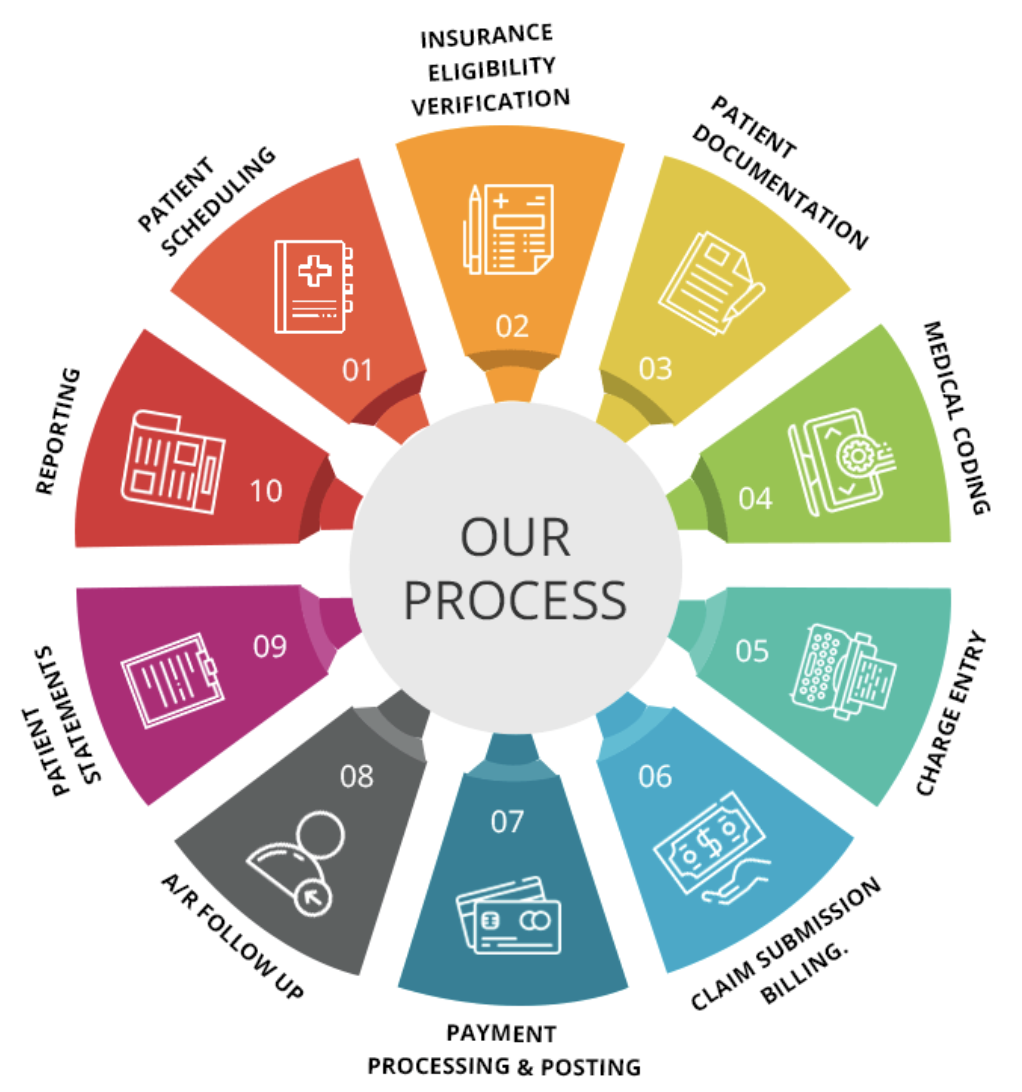
How Our Medical Billing Process Works
1. Start With a Billing Review
We begin with a 30-minute review of your AR aging, denial patterns, payer mix, and current billing workflow. The goal is simple: identify what is actually costing you money and where we would start.
2. Build the Revenue Recovery Plan
We identify the accounts, payer issues, coding patterns, workflow gaps, and filing risks that deserve attention first. You get a clear view of what should be worked immediately and what needs a process change.
3. Start With the Oldest Money
Working aged AR comes first because it represents revenue you have already earned. Our team works the backlog while establishing a consistent process for new claims and daily billing.
4. Run the Full Cycle
Once the foundation is in place, we take over the agreed portion of the revenue cycle: eligibility, coding, submissions, payment posting, denials, appeals, AR follow-up, patient billing, and reporting.
5. Improve the System, Not Just the Claims
The goal is not to create a permanent cycle of denials and appeals. We look for repeatable patterns so the practice can prevent the same billing problems from occurring again.
Why Nebraska Practices Choose Luxen
20+ Years of Revenue Cycle Experience
Medical billing is not a process you learn from a checklist. Payer behavior, documentation, coding, authorization, and follow-up all require experience. Luxen brings more than two decades of experience to the revenue cycle.
Certified Coders
Coding quality affects everything downstream. Our billing operation includes certified coding expertise so claims are built with greater attention to documentation and payer requirements.
Your Existing EHR and Practice Management System
You do not have to replace the software your practice already uses. Luxen works within your existing system, including platforms such as athenahealth, DrChrono, ModMed, AdvancedMD, NextGen, eClinicalWorks, Meditab, OpenDental, and other systems.
A Named Team, Not a Random Support Queue
You should know who is responsible for your claims. Our model is built around dedicated people working inside your systems and learning the way your practice operates.
HIPAA-Compliant Workflows
Before accessing protected health information, we sign a business associate agreement, and healthcare engagements operate through HIPAA-compliant tooling.
AAPC, AHIMA and SOC 2
Luxen combines billing expertise with professional credentials and documented security and compliance standards, including AAPC and AHIMA expertise, HIPAA-compliant workflows, and SOC 2.
We Read the Numbers Before We Quote
We do not want to sell you a generic percentage based on a generic practice. We look at your AR aging, volume, specialty, payer mix, and denial profile first.

Medical Billing in Nebraska: Understanding the Payer Landscape
One carrier dominates employer coverage here. On 2024 KFF data, Blue Cross and Blue Shield of Nebraska holds 80% of the fully insured large group market, 170,454 of 213,098 enrollees, and 46% of small group. The individual market runs the other way, with Centene companies holding 56% of it.
The 2026 exchange has five issuers, each selling in all 93 counties: Ambetter Health, Blue Cross and Blue Shield of Nebraska, Medica, Oscar, and UnitedHealthcare, per the CMS plan year 2026 landscape file. Contract status has to be checked plan by plan, not carrier by carrier, because a practice can be in network with one product from an issuer and out on another.
Medicare covers 383,528 Nebraskans. Medicare Advantage takes 33.8% of them, against roughly 55% nationally. Two thirds of the state’s Medicare book is still traditional fee for service, going to WPS as the Jurisdiction 5 Part A and Part B contractor for Iowa, Kansas, Missouri and Nebraska. A denial playbook written for a majority Advantage state points the wrong way in Nebraska.
Medicaid runs as Heritage Health, covering physical health, behavioral health and pharmacy under one contract. Combined Medicaid and CHIP enrollment was 332,232 in May 2026. Three plans have held the contracts since January 1, 2024: Molina Healthcare of Nebraska, Nebraska Total Care, and UnitedHealthcare Community Plan.
Healthy Blue held about a third of the book under the previous contract and was not re-selected. Any roster, contract or eligibility routine that was never re-papered at that changeover can still be a live source of denials two and a half years later.
Expansion coverage, approved by voters in 2018 and effective October 1, 2020, carried 67,384 newly eligible adults as of June 2025. The uninsured rate for Nebraskans under 65 sits at 9.1%.
Enrolling with Nebraska Medicaid does not put a provider in network with the plans. Those are separate contracts, three of them, on top of state enrollment and revalidation through the Provider Data Management System. Practices that treat this as one step find out at the first remittance.
Nebraska Billing Rules That Can Affect Your Revenue
6 months from date of service, Nebraska Medicaid
Timely filing
30 days electronic, 45 days paper, to pay or deny a clean claim
Prompt-pay requirement
Nebraska Medicaid, delivered through Heritage Health managed care
State Medicaid program
Neb. Rev. Stat. 44-8004 gives an insurer 30 calendar days from receipt to pay, deny or settle a clean claim filed electronically. Paper claims get 45. Late payment accrues 12% annual interest under 44-8005, running from the date payment came due.
Then there is the part almost nobody bills against. Section 44-8002(5) lets an insurer file a compliance statement with the Department of Insurance certifying it paid, denied or settled more than 90% of clean claims on time across the 24 months ending June 30. Filed by December 1, that statement exempts the insurer from the interest requirement. The interest most practices assume they are owed can be switched off in advance, in writing, once a year.
So the clock worth working is the other one. An insurer that wants more information has 30 days from receipt to ask for it, and a claim cannot be denied only because supplemental information was not supplied when supplying it was not reasonably feasible. A request that arrives well after that window is a timing argument. Nebraska also runs a prompt pay complaint form that providers can file directly.
The Act does not cover everyone. Medicaid, workers compensation carriers, motor vehicle and property insurers, risk management pools and self-funded employer plans all sit outside it under 44-8002(4). Applying a blanket 30-day follow-up rule across a whole AR file produces a lot of wasted calls.
Nebraska Medicaid runs on its own numbers, and they are tight. Under 471 NAC 3-003.01 a claim has to be received within six months of the date of service. An adjustment or resubmission is due within 90 days of the payment or denial date shown on the remittance advice. Nothing is paid past two years from the date of service. Third party liability claims get 12 months for health insurance and 24 months for casualty.
Six months is the number to build the calendar around. A practice that reconciles quarterly and reviews rejections at the end of the cycle has spent half its filing window before anyone has looked at the claim.
Prior authorization changed this year. LB 77, the Ensuring Transparency in Prior Authorization Act, was signed June 4, 2025, and most of it took effect January 1, 2026. Urgent requests get a decision inside 72 hours, dropping to 48 hours on January 1, 2028. Non-urgent requests get seven days. A new utilization review agent has to honor an existing approval for at least 60 days, and a denial cannot rest solely on artificial intelligence. The Department of Insurance publishes standardized prior authorization forms that every fully insured Nebraska plan has had to accept since January 1, 2026. Self-funded plans are not covered by any of it.
Workers compensation is a separate system with separate math. The Nebraska Workers’ Compensation Court sets the fee schedules under Neb. Rev. Stat. 48-120, built on CMS relative value units and adjusted annually, with the current schedules effective for services on and after January 1, 2026. Payment is the lower of the schedule amount or the billed charge. Under 48-120(1)(e) a provider cannot collect anything above the schedule from the employer, the insurer or the injured worker, and that bar includes finance charges and late penalties. There is no statutory day count for submitting or paying a workers compensation medical bill, so the schedule and the contract are the only things holding the timeline.
Telehealth pays at parity, with a condition attached. Neb. Rev. Stat. 44-312 requires reimbursement at least equal to the comparable in-person service, but only where the provider also delivers care at a physical location in Nebraska or holds privileges at a licensed Nebraska facility. Coverage parity under 44-7,107 has applied to policies issued or renewed since August 24, 2017. Practices leaning on out-of-state telehealth coverage should read that condition before assuming the rate.
Credentialing has no deadline at all. The Health Care Professional Credentialing Verification Act at 44-7001 to 44-7013 requires a carrier to verify credentials before it contracts, and to apply its own written standards consistently. It sets no turnaround time and mandates no uniform application. Nebraska’s Uniform Credentialing Act, in Chapter 38, is professional licensure through DHHS and is a different thing entirely. Plan the enrollment calendar as if nothing is owed to you, because nothing is.
Nebraska Medical Practices We Serve
We bill for nephrology and dialysis, where facility payment moves per treatment rather than per month, the CY2026 ESRD base rate is $281.71 per treatment, and a treatment that never made it onto a claim is a straight loss.
We bill for family medicine, internal medicine and pediatrics across rural Nebraska, where a rural health clinic is paid on an all-inclusive encounter rate and a critical access hospital settles against cost. Neither behaves like the fee for service logic most billing software defaults to.
We bill for behavioral health, where 88 of Nebraska’s 93 counties sit inside a mental health shortage area and a large share of visits arrive by telehealth, which puts the 44-312 in-state condition in front of every rate question.
We bill for orthopedics, physical therapy, pain management and occupational medicine, where the workers compensation schedule effective January 1, 2026 sets the ceiling and 48-120(1)(e) closes off any attempt to bill the difference.
We bill for dental and ambulance providers, where the argument is usually about who owes the balance, and Nebraska’s Out-of-Network Emergency Medical Care Act at 44-6834 to 44-6850 decides part of that answer after an emergency.
Serving Major Nebraska Markets
Luxen supports these markets remotely, inside the software your practice already uses.
Omaha
Lincoln
Bellevue
Grand Island
Kearney
Fremont
Norfolk
Columbus
North Platte
Scottsbluff
Omaha holds 488,797 residents and Lincoln 301,522, out of 2,018,006 statewide on the Census Bureau’s July 2025 estimates. Everything after those two is small and far apart. Nebraska DHHS puts rural hospitals at more than 68% of the state’s hospitals against 35% nationally, with 88 of 93 counties rural or frontier and 66 of them designated primary care shortage areas. A clinic in Scottsbluff or North Platte is often the only option inside an hour, which changes what a denied claim costs the patient as well as the practice.
We run the same model in other states, with the payer rules, filing windows and Medicaid structure rebuilt for each one. See California medical billing, Texas medical billing, Florida medical billing, New York medical billing, Pennsylvania medical billing, Illinois medical billing, Ohio medical billing, Georgia medical billing, North Carolina medical billing, Michigan medical billing, New Jersey medical billing, Virginia medical billing, Washington medical billing, Arizona medical billing, Massachusetts medical billing, Tennessee medical billing, Maryland medical billing, Colorado medical billing, Minnesota medical billing, Alabama medical billing, Louisiana medical billing, Oklahoma medical billing, Connecticut medical billing, Utah medical billing, Iowa medical billing, Maine medical billing, Hawaii medical billing, Delaware medical billing, Vermont medical billing, Alaska medical billing, Montana medical billing, Wyoming medical billing, Indiana medical billing, Kentucky medical billing, Missouri medical billing, New Hampshire medical billing, Oregon medical billing, Rhode Island medical billing, South Carolina medical billing, Mississippi medical billing, North Dakota medical billing, South Dakota medical billing, Arkansas medical billing, Idaho medical billing, Kansas medical billing, Nevada medical billing, New Mexico medical billing, West Virginia medical billing, and Wisconsin medical billing, or start from the full list of medical billing companies and what each one charges.
What Nebraska Practices Say About Working With Luxen
“Our dialysis treatment logs and billing records lived in separate systems, so incomplete patient months were difficult to identify. Luxen reconciled every treatment cycle, found 68 months that had not been billed correctly, and recovered $57,600 during the first quarter.”
Practice Administrator, Nephrology and Dialysis Group, Omaha, Nebraska
“When a payer did not respond quickly, our team often submitted the claim again instead of checking its status first. Luxen introduced a claim-status workflow that reduced duplicate submissions by 88% and saved our billing staff more than 22 hours of rework each week.”
Operations Director, Multi-Location Family Medicine Practice, Lincoln, Nebraska
More engagements are written up in our dental practice case study and our ambulance billing case study.
What Does Medical Billing Cost in Nebraska?
3% to 6% of collections
Luxen's pricing generally falls between 3% and 6% of collections, depending on claim volume, specialty, payer mix, and how much of the revenue cycle your practice hands over.
Larger-volume practices can generally access the lower end of the range because billing economics improve as claim volume increases. A smaller or more complex practice may fall toward the higher end because the amount of work per account is greater.
For comparison, published billing-industry pricing guides commonly place percentage-based medical billing somewhere around the mid-single digits, with higher ranges for smaller or more complex practices.
The more important question, however, is not whether a billing company charges 3%, 4%, 5%, or 6%.
It is what happens to collections after you hire them.
A lower fee attached to weak billing is still expensive.
The Risks of Outsourcing Your Medical Billing
Outsourcing is not automatically the right choice for every practice.
A billing company is a poor fit if you are unwilling to share operational visibility, if the vendor uses a rotating pool of people who do not learn your practice, or if the company cannot explain why your claims are being denied.
There is also a real risk in choosing a vendor that promises aggressive collection improvements without understanding your payer mix and specialty.
That is why Luxen starts with the numbers.
You should see the AR aging. You should understand your major denial categories. You should know what is being worked. And you should know what your billing company believes is realistically recoverable.
The right outsourcing relationship should make your revenue cycle more visible, not less.
How Much Revenue Are You Missing?
Look at your AR aging.
- How much is sitting past 90 days?
- How much is past 120 days?
- Which payers represent the largest outstanding balances?
- What are your top five denial reasons?
- How many claims are repeatedly resubmitted without a clear resolution?
- How much patient responsibility remains uncollected?
- How many claims are approaching a filing deadline?
Those numbers tell a story.
Send us your AR aging and we will tell you where we would start.
A Message From the Luxen Founder
I started Luxen because medical practices should not have to choose between doing great clinical work and running a financially healthy business.
Billing is too important to be treated as an afterthought. When claims are submitted incorrectly, denials sit untouched, or aged AR is ignored, the practice feels it everywhere, from cash flow and payroll to staffing decisions and growth.
Our job is to bring discipline to that part of the business.
We work inside the systems practices already use, build accountable billing workflows, and focus on the revenue that is actually recoverable.
We believe your billing partner should know your numbers, your specialty, your payers, and your practice, not just your account number.
Shivam Pujara
Founder, Luxen Talent (& Madhupa)
More on how we built the Luxen billing team.
.avif)
Transparent, U.S.-Focused Billing Support
Your Practice Keeps Its Systems
You do not need to switch EHR or practice management software to work with Luxen.
Your Data Stays Protected
Luxen healthcare engagements use HIPAA-compliant workflows, and we execute a business associate agreement before accessing protected health information.
Your Team Knows Who Owns the Work
We use a dedicated team model so responsibility does not disappear into a generic support queue.
You Can Start With Aged AR
Many practices begin with their old AR before moving into the daily revenue cycle. That gives both sides the opportunity to demonstrate results before expanding the engagement.
Nebraska Medical Billing FAQs
Why outsource medical billing in Nebraska?
Nebraska runs two short clocks that catch practices out. Nebraska Medicaid accepts claims for only six months from the date of service, and corrections for 90 days after the remittance advice. Commercial insurers owe 12% annual interest on late clean claims, but any insurer that filed a compliance statement with the Department of Insurance by December 1 owes none of it. A billing operation that tracks both is worth more than one that tracks neither.
Do you work with Nebraska Medicaid and Heritage Health?
Yes. We bill Nebraska Medicaid fee for service and all three Heritage Health plans: Molina Healthcare of Nebraska, Nebraska Total Care, and UnitedHealthcare Community Plan, which have held the contracts since January 1, 2024. Enrolling with Nebraska Medicaid does not put a provider in network with those plans, so we handle the state enrollment and the three separate contracts, and we watch the six-month filing window on every claim.
How do you handle denied claims?
We work every denial to resolution, then find the pattern behind it, which is usually a short list of causes repeating. In Nebraska one of those causes is worth arguing instead of correcting. Under Neb. Rev. Stat. 44-8004 an insurer has 30 days from receipt to request additional information, so a denial for missing documentation that lands months later is a timing argument, not a resubmission.
Is this cost-effective for a small Nebraska practice?
Usually, because the fee moves with collections. At 3% to 6%, a two-provider clinic in Kearney or Norfolk gets coverage it cannot staff internally, including the 90-day Medicaid correction window and the prior authorization turnarounds that took effect January 1, 2026 under LB 77. The number worth comparing is what a six-month filing deadline costs when nobody is watching it.
Book a Billing Review
You do not need another sales presentation.
Bring your AR aging, your denial data, and the questions you already have about your billing operation.
In a 30-minute Billing Review, we will look at where your revenue is sitting, where claims are breaking down, what we would prioritize first, and what outsourcing would cost based on your practice.
Send us your AR aging. We will tell you what we believe is recoverable.
